VMRD Insulin Validation Report

Summary
The VMRD Insulin test is a lateral flow assay that offers objective quantitation of equine insulin values in whole blood using the VMRD Reader, also used for VMRD SAA and Foal IgG. As with other VMRD patient-side tests, this assay is calibrated against an accepted reference test, which in this case is the radioimmunoassay (RIA) offered by the Cornell Animal Health Diagnostic Center (AHDC). Every test lot is individually calibrated for maximum quality control to ensure consistency and accuracy of results over time and between lots. The calibration system keeps results consistent over time using RFID cards
that are programmed with specific details for each lot and attached to the side of the reader when running the test.
Tests must be stored refrigerated (2-8°C) and then warmed to room temperature before use. For accurate results they must be run at a temperature between 60-85°F (15-30°C), otherwise results may be higher (high temperatures) or lower (low temperatures) than expected. Although temperatures outside that range are often encountered in the field, results will be most reliable if these guidelines can be followed, particularly when tracking values for an individual over time.
Each test comes with all components to run the test. The specific volume of blood sample needed is collected using a sampling pipette and then diluted in buffer. Five drops of diluted sample are applied to the test cartridge, and the test is run for 15 minutes either using the
self-time function on the reader or timed by the user. Results are then interpreted and displayed by the reader, with numerical values reported between 20-200 μIU/mL.
The VMRD Insulin test gives veterinarians the right information to provide immediate results and recommendations to owners for effective care and management of horses with insulin dysregulation (ID), allowing them to tailor management strategies to the needs of the individual horse.
Comparison to RIA reference standard
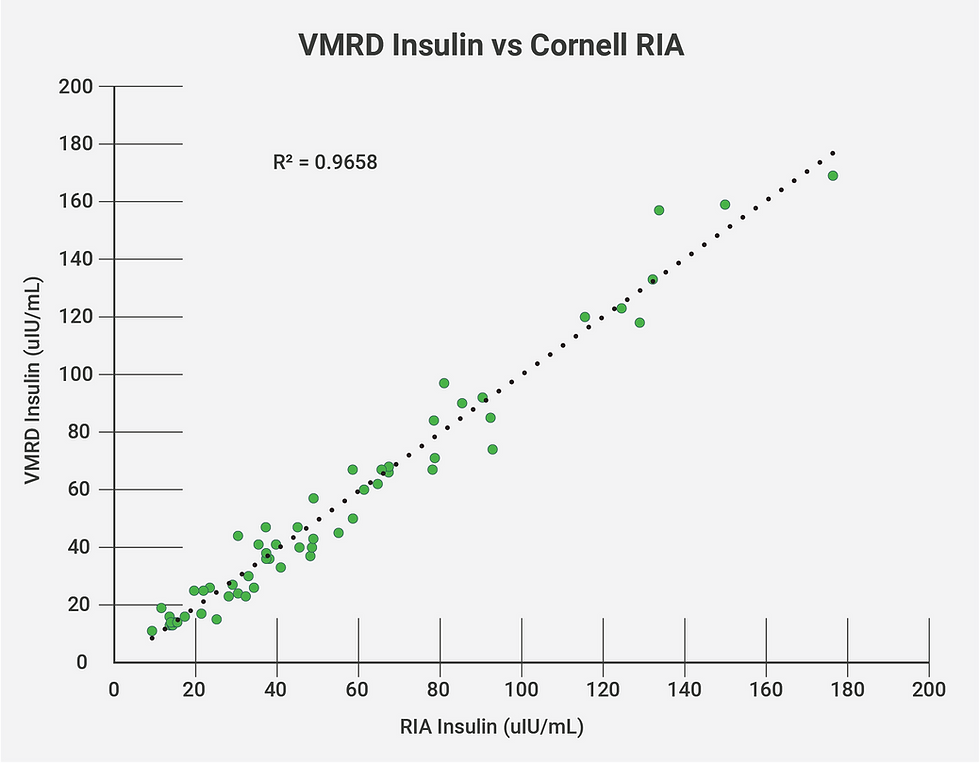
Excellent correlation was observed between the VMRD Insulin test and the reference test for general field samples and samples taken during oral sugar tests for horses with ID.
Field samples
The insulin concentrations of 58 field samples from 27 equids (24 horses and 3 mules) were determined with reference testing at the Cornell AHDC, then compared with the results from the VMRD Insulin lateral flow test. This sample set included seven individuals with diagnosed ID, each with multiple oral sugar test timepoints. Three to five test replicates were performed for each sample. Correlation of lateral flow with RIA for these samples was excellent with an R² value of 0.966. (Figure 1)
Oral sugar tests
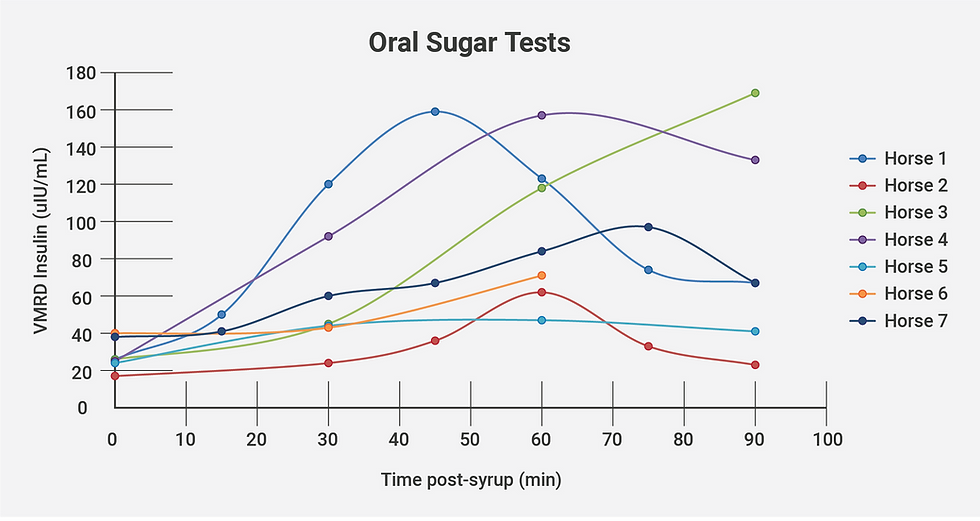
Low-dose oral sugar tests were performed on seven horses suspected of having ID but whose baseline insulin concentrations were below the clinical cutoff of 45 μIU/mL (1). (Figure 2) All seven horses were diagnosed with ID and subsequently considered at high risk of hyperinsulinemia-associated laminitis according to the Equine Endocrinology EMS Guidelines (1).
Dilution curve
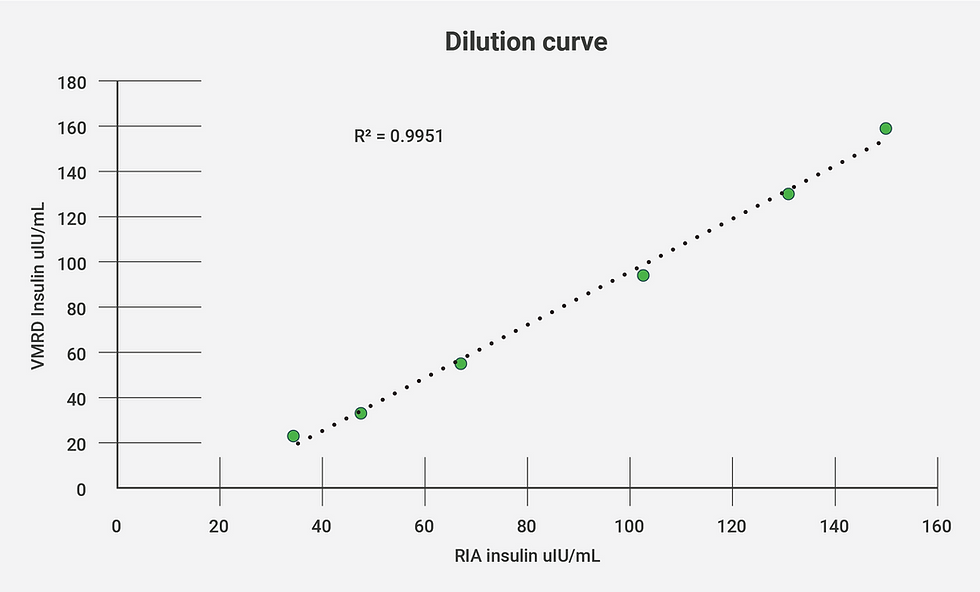
Using samples collected during the course of an oral sugar test, equine blood with a moderately high insulin concentration (45 min sample) was diluted at various ratios with blood containing a low concentration of insulin (”Pre” sample) from the same horse. Each dilution was tested in triplicate by the same user, and plasma was harvested and sent to the
Cornell ADHC to characterize the exact insulin concentrations. Across the tested range of 34 to 150 μIU/mL, the VMRD Insulin test had excellent correlation with the reference test, with an R² value of 0.995. (Figure 3)
Test variability
Intra- and inter-assay variation
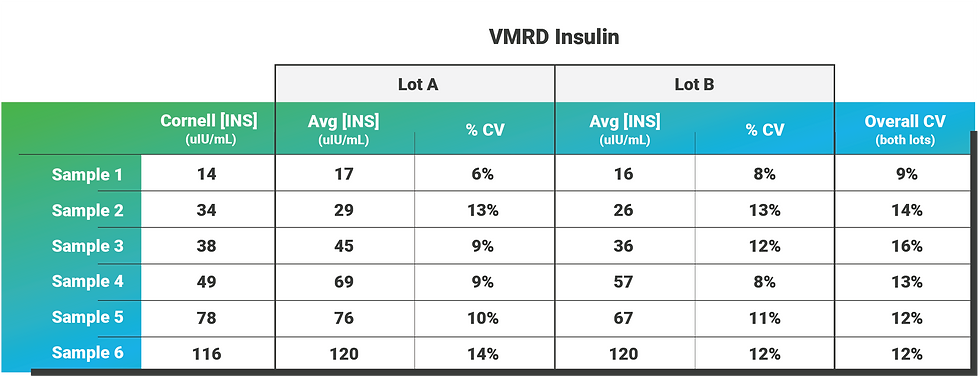
Two lots of tests were compared with one technician running 10 replicates from each lot on six samples ranging in concentration from 14 to 116 uIU/mL. For intra-assay variation, CVs ranged from 6 to 14% for Lot A (average 10%) and from 8 to 13% for Lot B (average 11%).
Inter-assay variation showed CVs ranging between 9 and 16% across all samples when encompassing data from both lots, with an average CV of 13%. (Table 1) This demonstrates good consistency between lots, with variation comparable to that observed in results obtained through submission to the reference lab (see below).
Inter-runner variability
Variation was further evaluated by two technicians using three blood samples of various concentrations (14, 38, and 78 μIU/mL) as determined by Cornell. Each technician ran five replicates, for a total of 10 replicates of each sample. Variation ranged from 7-11% with an
average variation of 9.3%.
Reference RIA test variation
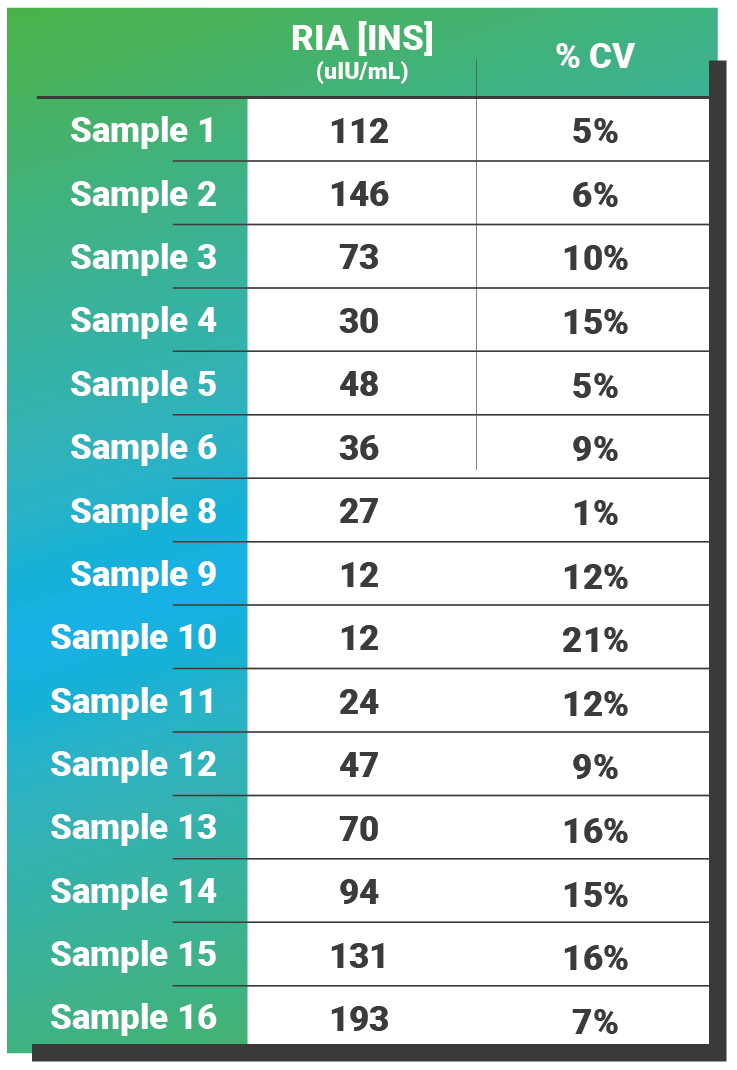
To evaluate the inherent variability of the reference test used for calibration and validation of the VMRD Insulin test, 15 plasma samples (8 individual and 7 pooled) of varying concentrations were submitted to the Cornell ADHC for testing by RIA. Samples were tested in three separate runs on different days, and %CV ranged from 5-21%. (Table 2) This demonstrates that the level of variability observed with the VMRD Insulin test is also consistent with what can be expected from submission of samples for laboratory testing. Since the insulin values of each sample were defined by this reference test, no further assessment could be made regarding the accuracy of each value.
Conclusion
The VMRD Insulin test correlates very well with the gold standard RIA test run by the Cornell ADHC, providing accurate, quantitative results using the VMRD Reader. Results for both normal and ID horses were clinically accurate across a broad range of insulin concentrations and supported rapid diagnosis of ID in multiple horses used for this study. Assessment of test variability demonstrated consistent results between runners and between lots, comparing favorably to the RIA reference test.
The VMRD Insulin test offers a new, high-quality option for horse-side measurement of equine insulin in whole blood, without the delay and hassle of sending out samples or having to spin down samples and run them in a lab space. Testing horse-side enables dynamic assessment of insulin values to immediately evaluate the effect of current feeding and
management strategies and offer timely recommendations for the prevention of hyperinsulinemia-associated laminitis.
References
Equine Endocrinology Group. (2024). Recommendations of diagnosis and management of equine metabolic syndrome (EMS), including assessment of insulin status. https://equineendocrinologygroup.org/

লেখাটি পড়ে jaya 999 সম্পর্কে বেশ কিছু দরকারি বিষয় জানা গেল। তথ্যগুলো অপ্রয়োজনীয়ভাবে বড় না করে সহজভাবে উপস্থাপন করা হয়েছে, তাই পড়তে ভালো লেগেছে। বিশেষ করে নতুন ব্যবহারকারীদের জন্য নিরাপত্তা, অ্যাকাউন্ট ব্যবস্থাপনা এবং গুরুত্বপূর্ণ শর্ত সম্পর্কে পরিষ্কার ধারণা থাকা দরকার। এমন তথ্যভিত্তিক পোস্ট আরও দেখতে চাই।
I found the VMRD Insulin test interesting because it offers a practical way to measure equine insulin directly at the horse’s side, reducing delays from sending samples to a laboratory. The comparison with the RIA reference test also highlights its consistency. I enjoy that same focus on quick feedback in Slope Rider, a browser game where I steer downhill, react to obstacles, and adjust with each run.